

Amazing Grace Guitar Lesson
 I’m going to spend some time concentrating on the idea of chord melodies and the arrangement of songs for the single guitar, as opposed to the guitar as accompaniment for the singer. There are all sorts of reasons for this, but I think the best one is that this will be an easy way to focus on techniques as well as driving home some lessons on chord structure, chord substitutions and other ideas from music theory that you’ll be able to use in all your playing, whether in this style or any other.
Further Reading
And we’ll start off with Amazing Grace, a simple three-chord spiritual that I’m sure pretty much everyone knows. The song’s history is incredibly interesting enough to be a book of its own, which it is! John Turner has written a wonderful and insightful book called, appropriately enough, Amazing Grace, which traces the song from its African and Scottish roots all the way to modern recordings of it by artists such as Judy Collins, Elvis Presley, Ladysmith Black Mambazo, Al, Green, Rod Stewart, Chet Baker, Tiny Tim, Destiny’s Child and Johnny Cash. By the way, if you want to hear what I think is the definitive arrangement of this song, get a copy of Jubilation by the Holmes Brothers and have a listen. Even better, see them live whenever you get the chance!
Our version, while much, much simpler, will have some charms all its own. We’ll first explore how to go about picking a key and then use the song as an exercise in developing the “voice” of your guitar. And, of course, we’ll also throw in a bit of theory, not to mention a look at chord voicing and a slightly altered tuning. After all, this is one of my lessons, right? Intrigued? Then, by all means, let us proceed…
 Since Amazing Grace is a relatively short song, I think that the best approach will be to take it line by line. But before we even get to that, let’s decide upon a key in which to play. I’ve seen (and heard) this piece played in almost every possible key. Opening a nearby book (and woe to the guitarist who doesn’t own any books!), I see it done in the key of G. Let’s look at the melody in that key, broken down line by line:
This certainly seems simple enough. But if you’ve read my other pieces on arranging, you already know I’m going to have a problem with it. Namely, there’s too much of the melody going on below the G string. This will mean a bass-y arrangement, which, in and of itself, is not necessarily a bad thing, but I’d like to get more of the higher strings of the guitar involved. Using this version, we won’t even touch the high E (first) string! And where’s the fun in that?
 I’ve also got another bee in my bonnet. Somewhere, in a corner of the incredibly vast, invariably cluttered warehouse I call my mind, I’ve got a thing about bagpipes. Usually I can ignore it, but something about Amazing Grace triggers this reaction. It may simply be that I was exposed to way too many repeated listenings of that pipe band version of this song, which was a big hit when I was (somewhat) younger. I’m sure that I’ll get a lot of emails telling me the name of the band, so I’ll try to remember to pass the word along to those of you who might be interested in this sort of thing.
Be that as it may, I know that I have stumbled upon an idea that I’m not going to let go until I work it out of my system. I guess that means you’re stuck with it, too! Maybe it wasn’t the bagpipes at all as much as it was a rereading of an old article of mine, , which gave me this craving. I don’t know.
But I do know, after spending the better part of the day trying out various permutations of this song, that there are a lot of fun things we can do with Amazing Grace. And the very first thing we’re going to do, as I mentioned before this digression, is to choose a key in which to play it.
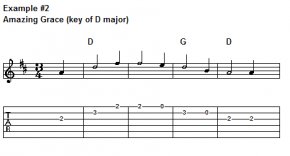
And I’m opting for D major for three reasons. First, you might have noted that the melody line of Amazing Grace spans the range of one octave. In the example we just saw, it goes from D (open D string) to D (third fret on the B string). Since D is the fifth in the key of G and since I’d like to keep things fairly simple, using the key of D will mean our melody will range from A on the second fret of the G string to the A note on the fifth fret of the first (high E) string. We (hopefully) won’t be fumbling around looking for our melody notes! Here they are:
The second reason concerns my Celtic preoccupations. Being in the key of D, there’s no reason I can’t use Drop D tuning to create a cool drone on my lower strings. For those of you who may not be familiar with Drop D tuning, you can take a moment and go read another of my old articles, and one, I might add, with a terrific pun for a title. There you’ll find that changing from standard tuning to Drop D simply requires you to lower the tone of the low E (sixth) string down one step to D. You can do this with a tuner or even by ear.
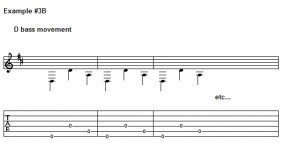 Being in Drop D, your three lowest strings will now be tuned (low to high) D, A and D, which some of you might recognize as a D power chord. Power chords, as we’ve noted in many articles here at Guitar Noise, are chords containing two notes, the root and the fifth. This interval of a fifth is the basis of many an instrument throughout history, bagpipes being one of the many that’s been around a bit longer than the electric guitar. It creates a drone over which you can play a melody line. And having those resonating open strings as our bass notes will, no pun intended, give our guitar much more body than if we were in standard tuning.
But it’s the third reason for choosing this key that I’d like to dwell on for our lesson today. Playing in the key of D allows us to use a lot of flourishes, that is, hammer-ons and pull-offs, that will give our arrangement style and character.
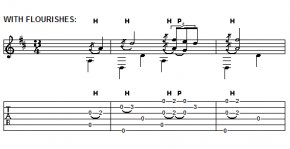
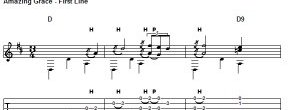
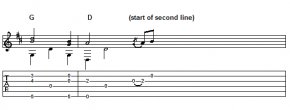
And you can hear that right from the very first notes:
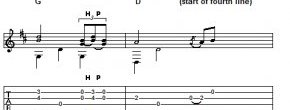
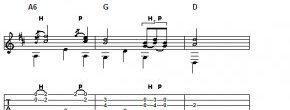
Quite a difference between those two styles, no? The first one is very much in the style of playing we’ve worked on in pieces like and it certainly will service this song well. But there’s a lot more movement, more drama, more panache if you will, in the playing of the second example here. We’re allowing our guitar to have a voice. We’re letting it sing ! We’re giving it some soul !
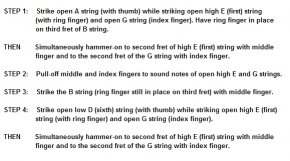
And it’s not all that hard to do! You can start out by fingering your typical standard open position D chord, with your middle finger on the second fret of the first (high E) string, your ring finger on the third fret of the B string and your index finger on the second fret of the G. Once you’re set, slightly raise your index and middle fingers off their respective strings, leaving the ring finger in place. Now, with your picking hand, simultaneously pluck the open A string with your thumb and the open G string with your index finger. As soon as you do so, hammer the index finger of your fretting hand back onto the second fret of the G string. You should hear the A and G notes start out together, with the G becoming an A (albeit an octave higher) almost immediately after.
YOU MIGHT ALSO LIKE

Share this Post
Related posts

5 string Bass Guitar Lessons
5 String Bass Guitar Info 5 String Bass Guitar Info The 5 String Bass – Now, Later, or Never? 5 String Bass Guitar Info –…
Read More
Beginning Bass Guitar Lessons
How to choose the right electric bass to keep the beginning bassist in the groove without busting your budget The bass guitar…
Read Morelatest post
-
 Eric Arceneaux Voice lessons October 27, 2026
 -
 Voice lessons Worcester MA October 22, 2026
 -
 Guitar lessons Jacksonville FL October 17, 2026
 -
 Themes in The Piano Lesson October 12, 2026
 -
 Good songs for Voice lessons October 7, 2026
 -
 Guitar lessons in London October 2, 2026
 -
 Guitar lessons Concord CA September 27, 2026
 -
 Fort Worth Guitar lessons September 22, 2026
 -
 Free Piano lessons for Adults September 17, 2026